Today in France, certain prohibitions are checked in just a few seconds…
But not when it comes to protecting an animal.
If you want to borrow from the bank, your file goes through the FICP File, and in a few seconds, it checks if you have had repayment incidents or a situation of over-indebtedness.
When a stadium ban is pronounced, there are systems in place that allow organisers to enforce it effectively.
If you want to enter a casino, the system checks if you are banned from gambling.
And yet…
A judge can convict a person for abuse, severe mistreatment, or abandonment of an animal and prohibit them from owning one, sometimes for life, whether it is a domestic animal, livestock, or a pet…
But NO FILE is accessible to shelters, veterinarians, or organisations that give away or sell animals.
Why such inconsistency?
On November 30, 2021, a law was passed to strengthen the fight against animal abuse, particularly by enhancing the effectiveness of penalties for prohibiting animal ownership.
Yet, five years later, the reality is quite different. While these bans are indeed pronounced by the courts, their enforcement on the ground is impossible. The information mainly exists through criminal records and judicial files (notably the Wanted Persons File FPR), but is only accessible to law enforcement.
They are not centralised in a specific tool that can be easily used on a daily basis.
Professionals who entrust animals daily are therefore deprived of the tool that would allow them to verify a prohibition that has been pronounced by the courts.
The judicial ban thus relies solely on the “goodwill” of the convicted individuals.
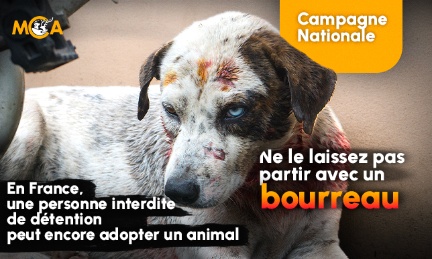
A person convicted of beating, torturing, or abandoning an animal and banned from ownership can thus, the very next day, present themselves at a shelter or with a breeder and leave with a new animal, with no means of verification to oppose it.
This is a true failure of the State in enforcing its own sanctions!
It is not possible to make the current files accessible because they contain sensitive criminal information and detailed records of convictions (specific reasons, duration of the sentence, elements of the judicial file…), and are not exclusively dedicated to animal welfare.
The State already knows how to identify individuals subject to a ban. The question is why no operational system has been put in place to allow those responsible for entrusting animals to verify this information in a simple, secure, and proportionate manner?
This is exactly what we are asking for: the creation of a simplified and secure file in which shelters, breeders, and sellers would only see a binary response (“Allowed” or “Banned from owning animals”), without any details on the conviction to ensure the protection of personal data.
It would not be a public register, but a professional tool regulated and comparable to those already existing (stadium, credit, gambling…).
We are not asking for the creation of new sanctions.
We are simply asking for the enforcement of those that already exist
Nearly 700 reports of abuse are recorded every month in France by the 3677 and yet we could prevent many of them…
Because the protection of animals cannot rely on luck or the good faith of already convicted individuals.
Because animals deserve to be protected as effectively as the money of banks or the stands of a stadium.
Today we are 20 committed actors in this national campaign, your voice matters more than ever, so join us, sign and share this petition!
#AFileForThem
Vous êtes sûr ? Votre mobilisation est importante pour que les pétitions atteignent la victoire !
Sachez que vous pouvez vous désinscrire dès que vous le souhaitez.
Les auteurs de la pétition