
Grande Campagne Nationale en cours :
Déjà plus de 150 000 signatures ! Aidez-nous à empêcher les auteurs de maltraitance frappés d'une interdiction de détention de reprendre un animal ! #UnFichierPourEux
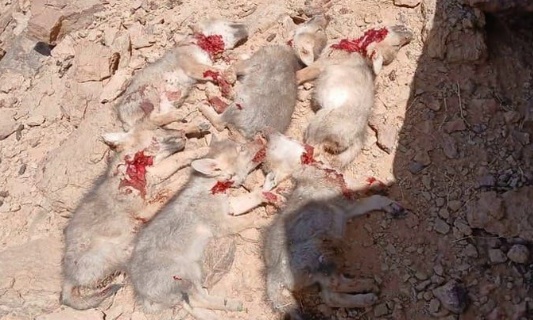

Le massacre de six louveteaux par trois nomades dans la région d'Errachidia, et la diffusion subséquente de photos de cette acte3horrible sur une application de messagerie, a suscité une vive indignation parmi les organisations environnementales et de la société civile au Maroc, ainsi que la mienne !!
Il s’agit d’un acte barbare, monstrueux, sur de très jeunes loups, et une violation des lois nationales et internationales protégeant la faune sauvage.
Selon plusieurs sources, les photos montrant les louveteaux égorgés les uns près des autres, ont d'abord été partagées au sein d'un groupe privé avant de se propager plus largement. La Gendarmerie royale de Rissani a rapidement ouvert une enquête approfondie.
Les services de sécurité ont recueilli les déclarations officielles des trois nomades afin de déterminer les circonstances de l'incident, le lieu où il s'est produit et leurs motivations. Les suspects ont été placés en garde à vue dans le cadre de l'enquête en cours. Les personnes interpellées ont expliqué leurs actes, affirmant craindre des attaques de loups sur leur bétail. Ils ont confirmé que l'abattage était une mesure de précaution .!!!!!!
Cet incident a relancé le débat sur les relations tendues entre les communautés pastorales et les prédateurs, notamment les loups, dans les zones de pâturage.
De son côté, un militant écologiste de la région de Rissani, a souligné que l'abattage de ces animaux, surtout lorsqu'ils sont jeunes, constitue un véritable scandale; il a cité les lois nationales et les conventions internationales ratifiées par le Maroc concernant la protection de la faune sauvage. et expliqué que les loups jouent un rôle écologique essentiel dans le maintien de l'équilibre de la chaîne alimentaire. Il a averti que le déclin continu de leur population, dû à un abattage indiscriminé, menace l'équilibre naturel des régions semi-désertiques.
Ce même militant écologiste a appelé à un contrôle plus strict et à la mise en œuvre de mécanismes de dissuasion prévus par la loi. Il a également insisté sur la nécessité de lancer des campagnes de sensibilisation auprès des communautés nomades et pastorales concernant les alternatives non létales à la protection du bétail. Des organisations de défense de l'environnement insistent également sur l'importance de mettre en place des mesures préventives concrètes, telles que des clôtures électriques ou des chiens dressés pour protéger les troupeaux. L'objectif est de garantir la protection des moyens de subsistance des populations locales sans perturber l'équilibre écologique.
Les militants parlent d'une culture de vengeance contre les loups, encore présente dans certaines communautés pastorales. Ils estiment que la solution réside non pas dans l'extermination, mais dans la coexistence grâce à des mesures préventives modernes.
Mais au niveau des autorités, les images des louveteaux égorgés auraient dû provoquer un sursaut national. Elles n’ont suscité qu’une réaction tiède, presque administrative, de la part des autorités marocaines. Auditions de routine, justifications attendues, puis silence. Ce mutisme face à un acte d’une telle cruauté en dit long sur la manière dont la question animale est traitée : comme un problème secondaire, voire négligeable.
Une réaction officielle déconnectée de la gravité des faits.
Au Maroc, la violence envers les animaux est tolérée sinon implicitement encouragée. Derrière les arguments de protection des troupeaux ou de gestion des risques, c’est une absence criante de politique cohérente qui apparaît. À force de laisser ferme et rester silencieux, les autorités installent une banalisation inquiétante de pratiques très cruelles hautement condamnables. Face à un crime aussi choquant, la réponse des institutions aurait dû être exemplaire. Or, elle donne le sentiment inverse : celui d’un système qui minimise, relativise et finit par excuser.
L’argument de la peur des éleveurs ne peut en aucun cas justifier l’abattage sauvage de très jeunes animaux.
C’est précisément dans ces situations que l’État doit intervenir avec fermeté, en proposant des alternatives crédibles et en sanctionnant ces dérives. Ce manque de rigueur envoie un message dangereux : celui que certaines violences sont acceptables si elles s’inscrivent dans des pratiques locales.
Cette posture fragilise non seulement la protection de la biodiversité, mais aussi la crédibilité des engagements environnementaux du Maroc sur la scène internationale. À quoi servent les discours officiels si, sur le terrain, rien ne change réellement ?
Tous comme pour les chiens errants qui continuent à être massacrés pour leur simple existence.
Mondial 2030 : une image ternie par l'immense cruauté envers les animaux.
La situation va devenir encore plus préoccupante à l’approche d’événements d’envergure tel que la Coupe du monde 2030. Alors que le Maroc cherche à projeter une image de modernité, des campagnes d’élimination d’animaux errants suscitent une grande indignation. Les témoignages et images diffusés évoquent des pratiques particulièrement choquantes : des milliers de trés pauvres animaux empoisonnés, animaux brulés, ou abattus froidement par balle, puis les laissant agoniser au sol dans d'importantes souffrances.
Vous êtes sûr ? Votre mobilisation est importante pour que les pétitions atteignent la victoire !
Sachez que vous pouvez vous désinscrire dès que vous le souhaitez.